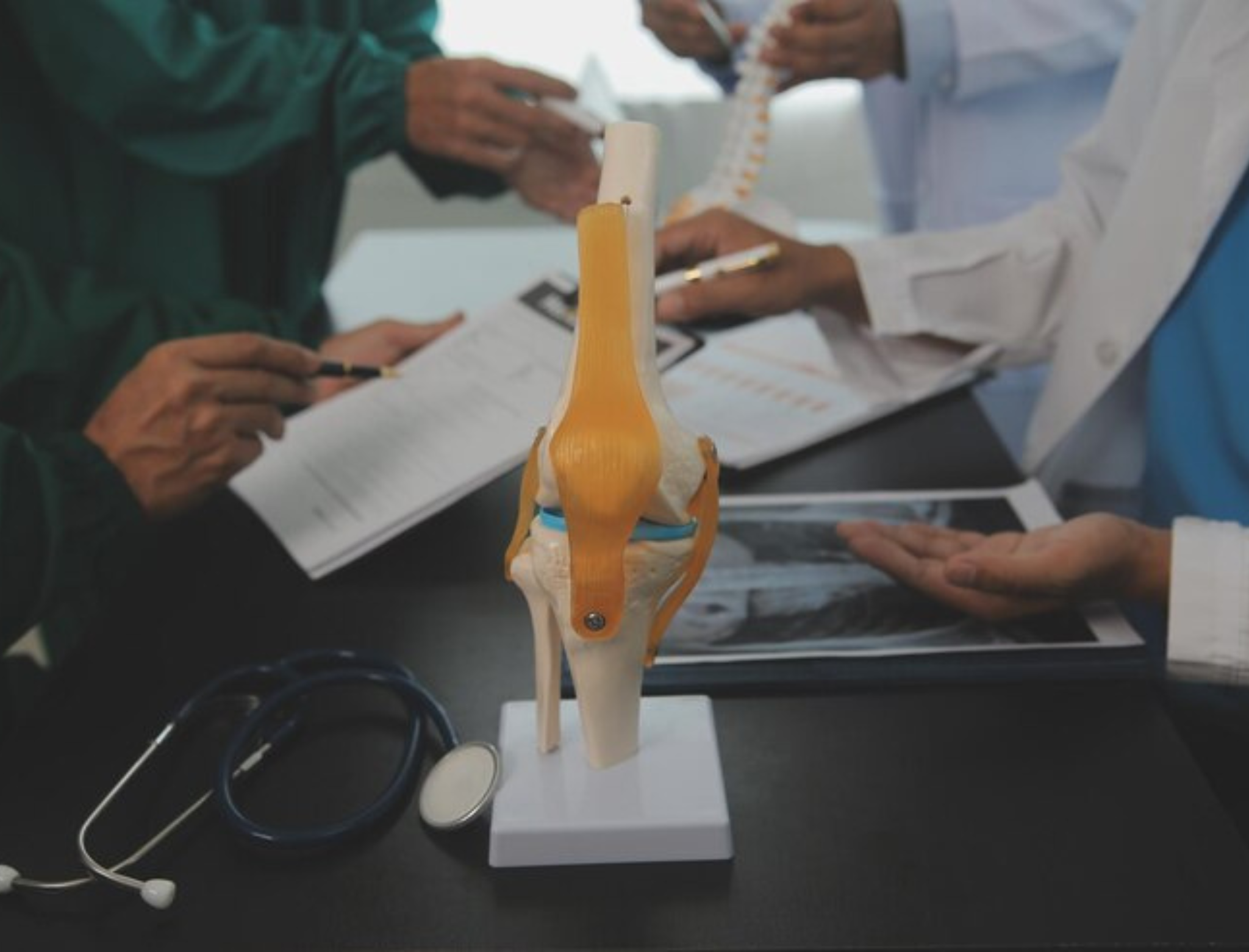
Total Knee Replacement
Total knee replacement is a surgical procedure to relieve pain, improve function and help you return to everyday activities.
Total knee replacement is a surgical procedure to relieve pain, improve function and help you return to everyday activities.
A total knee replacement (total knee arthroplasty) is a surgical procedure used to replace the painful and worn-out surfaces of the knee joint with an artificial prosthesis. Total knee replacement is a surgical procedure to relieve pain, improve function and help you return to everyday activities.
The most common reason for total knee replacement surgery is osteoarthritis. Other health conditions that cause knee damage include: rheumatoid arthritis and posttraumatic arthritis.
Total knee replacement surgery is commonly performed by orthopedic surgeons to relieve moderate to severe pain and disability when conservative treatments have not worked.
A surgeon makes an incision down the center of the knee, around 8 to 10 inches long, and cuts through deeper tissue, including the quadriceps tendon, and flips over the kneecap to access the femur and tibia. (Minimally invasive procedures use smaller incisions and minimally invasive surgical techniques.)
A total knee replacement (TKR) is a surgical procedure in which the arthritically damaged areas at the top of the tibia and bottom of the femur are surgically removed. The top of the tibia and bottom of the femur are reshaped to fit their new prostheses. Physicians use either a metal jig or computer assistance to precisely line up their cuts. The back of the kneecap, or patella, may be resurfaced and an implant attached for it to glide against its new joint. For patients who had this surgery, patella resurfacing does not provide better results than tissue repair in improving pain, strengthening muscles, walking ability, joint motion, and/or knee function over time.
The spacer is a thin, flexible cushion that's attached to the surfaces of the new tibia and femur. It serves as a shock absorber, protecting against friction caused by movement.
The surgeon flexes and extends the leg during the fitting process to ensure that the components are properly placed and that the motion of the new knee joint is smooth.
The surgeon straightens each bone to create proper alignment and stitch the ligaments in place. The cement is then injected into the joint to hold the prosthesis together.
During surgery, the surgeon will repair or realign the damaged cartilage, ligaments, and other deep tissue. The skin incision is stitched after all of the work is done.
After the Total Knee Replacement procedure, you will be taken to a recovery area for a few hours while the surgical anesthesia wears off. After the Total Knee Replacement procedure, you will be taken to a recovery area for a few hours while the surgical anesthesia wears off.
After resting for some time, you will be seen by a physical therapist, and if deemed appropriate you could be discharged home on the day of surgery. If though, you are not deemed safe for discharge on the day of surgery, you will be admitted to a hospital room where you will spend 1 to 2 days before being discharged.
With any major surgery, risks and complications may be present. Possible injuries that may occur from total knee replacement surgery include: